the great DiMaggio
The great DiMaggio, the New York Yankees center fielder, appears throughout The Old Man and the Sea not as a character but as a touchstone of excellence and endurance. Santiago, the old fisherman, carries the image of DiMaggio in his mind during his solitary battle with the giant marlin, using the ballplayer's legendary ability to perform despite pain as a model for his own conduct. DiMaggio becomes a secular saint in Santiago's private mythology, a figure whose greatness is measured not by fame but by the capacity to endure physical suffering without faltering.
The Symbol of Flawless Performance
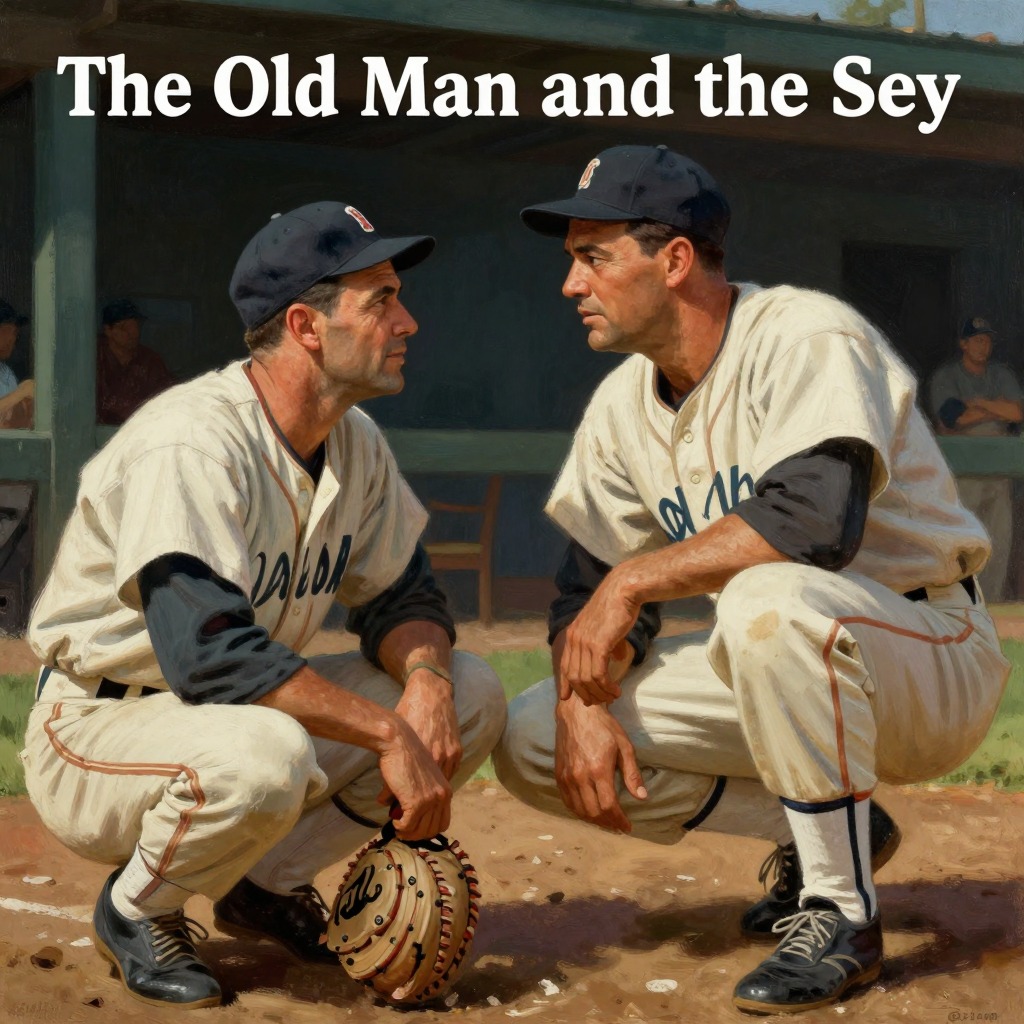
Santiago first invokes DiMaggio while talking with the boy Manolin on the evening before his fateful voyage. When Manolin expresses fear that the Cleveland Indians might beat the Yankees, Santiago responds with absolute confidence: "Have faith in the Yankees my son. Think of the great DiMaggio." For Santiago, DiMaggio is not merely a player but the embodiment of a principle: the one man who makes the difference between a good team and a great one. Later, alone at sea, Santiago returns to this thought, telling himself that "the great DiMaggio is himself again" after a single loss, as if the ballplayer's return to form were a natural law. This faith in DiMaggio's consistency mirrors Santiago's own need to believe that a man can rise to his best even after long stretches of failure.
The Measure of Suffering
As the struggle with the marlin stretches into its second day, Santiago's thoughts turn repeatedly to DiMaggio as a standard against which to measure his own pain. He knows that DiMaggio "does all things perfectly even with the pain of the bone spur in his heel," and he wonders whether a bone spur could be as painful as the spur of a fighting cock. Santiago has never had a bone spur, but he uses DiMaggio's example to frame his own suffering as something that can be borne: "I am sure he would and more since he is young and strong. Also his father was a fisherman." The connection is personal—Santiago imagines that DiMaggio, as the son of a fisherman, would understand the old man's life. When Santiago's hands are cut and cramped, when his back is raw from the line, he asks himself whether DiMaggio would have stayed with the fish as long as he has, and the answer he gives himself is a reaffirmation of his own resolve.
The Post-Battle Judgment
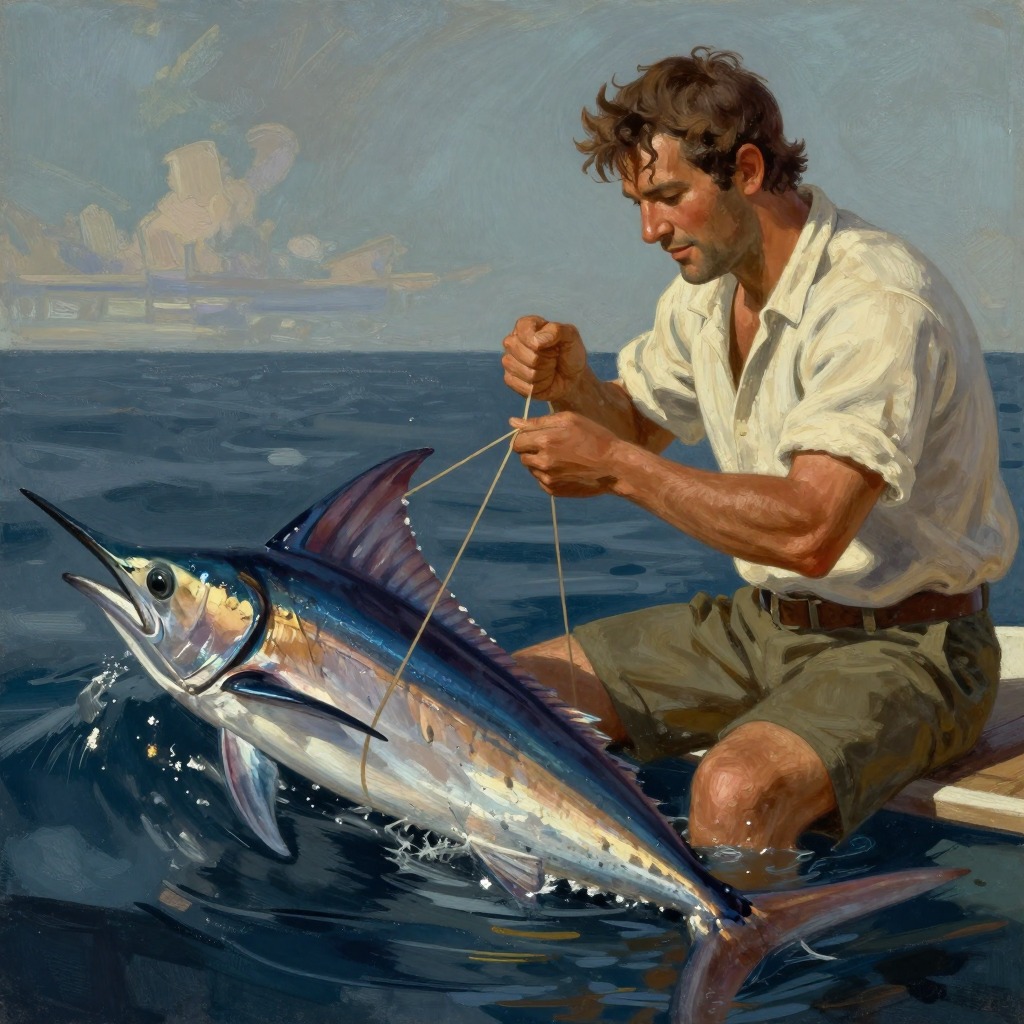
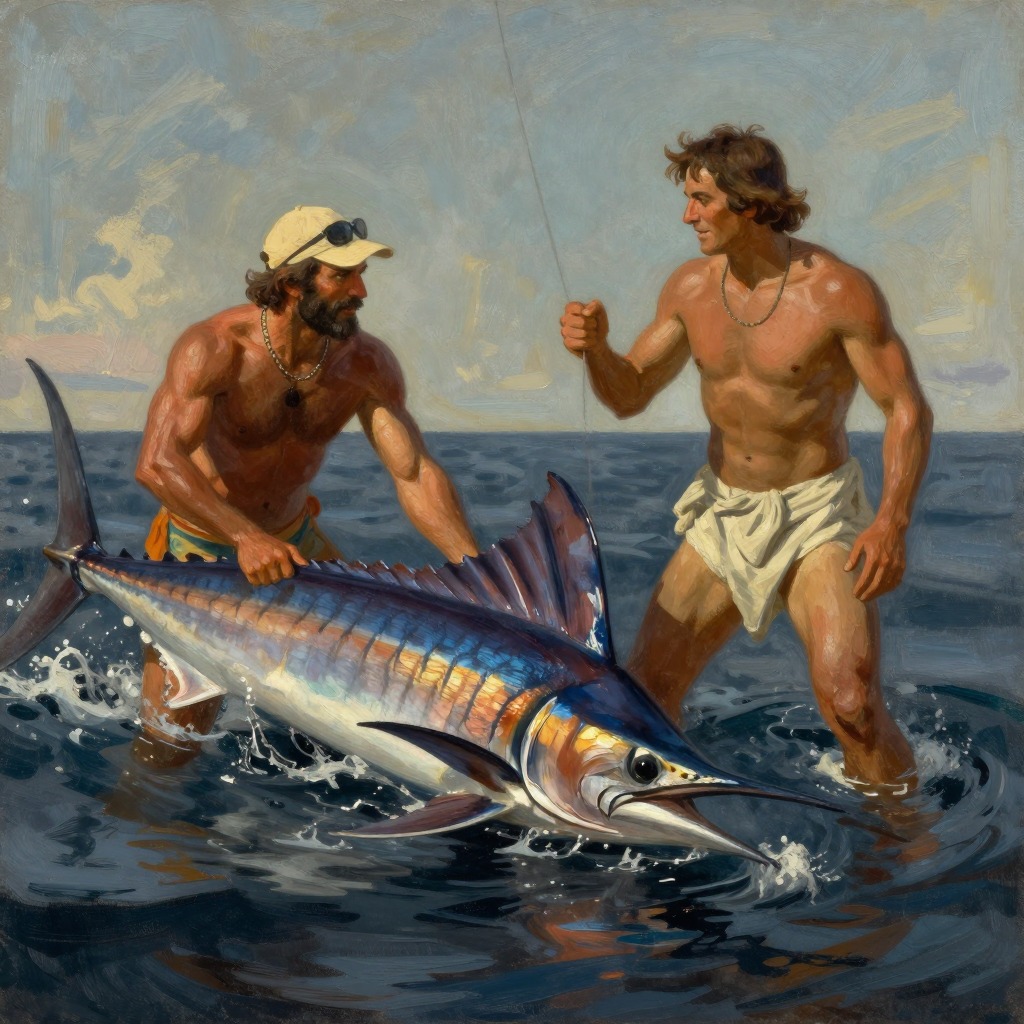
After killing the marlin and lashing it to the skiff, Santiago thinks of DiMaggio again, this time with a sense of earned pride. He estimates the fish's weight and says aloud, "I think the great DiMaggio would be proud of me today. I had no bone spurs. But the hands and the back hurt truly." The comparison is both humble and triumphant: Santiago acknowledges that he lacks DiMaggio's famous handicap, yet he has endured a trial that he believes would meet the ballplayer's standards. Later, as the sharks begin to destroy the marlin, Santiago wonders how DiMaggio would have liked the way he drove the harpoon into the Mako shark's brain. He dismisses the act as "no great thing," but the question reveals how deeply DiMaggio's imagined judgment matters to him—the ballplayer has become the internal witness before whom Santiago performs his code.
The Link Between Two Worlds
DiMaggio also serves as a bridge between Santiago's solitary life at sea and the larger world of human achievement. The old man has no radio on his skiff, but he thinks about the baseball games he cannot follow, and DiMaggio is the fixed point in that imagined scoreboard. When Santiago recalls that he once wanted to take DiMaggio fishing but was too timid to ask, the regret is not about lost fame but about a missed chance to share the thing he knows best with a man he admires. "They say his father was a fisherman," Santiago tells Manolin. "Maybe he was as poor as we are and would understand." This imagined kinship—between a poor Cuban fisherman and a wealthy American ballplayer—rests on the shared experience of work and pain, not on social status. DiMaggio, in Santiago's mind, is not a celebrity but a fellow laborer in the craft of doing something difficult under pressure.
The Thematic Significance
DiMaggio functions as a secular counterpart to the religious icons—the Sacred Heart of Jesus and the Virgin of Cobre—that hang on the wall of Santiago's shack. Where the religious pictures are relics of his dead wife, objects of a faith he practices mechanically, DiMaggio is a living symbol he actively consults. Santiago prays to the Virgin for the death of the fish, but he measures himself against DiMaggio. The ballplayer represents a purely human standard of excellence, one that requires no supernatural intervention: a man with a bone spur in his heel who still plays perfectly. In this way, DiMaggio embodies the novel's central assertion that a man can be destroyed but not defeated. Santiago's repeated invocation of DiMaggio is not escapism but a deliberate act of self-construction, a way of telling himself that the suffering he endures has meaning because it is witnessed—if only by the imagined gaze of a man who would understand.